




Global Stage Podcast
 About the Episode:
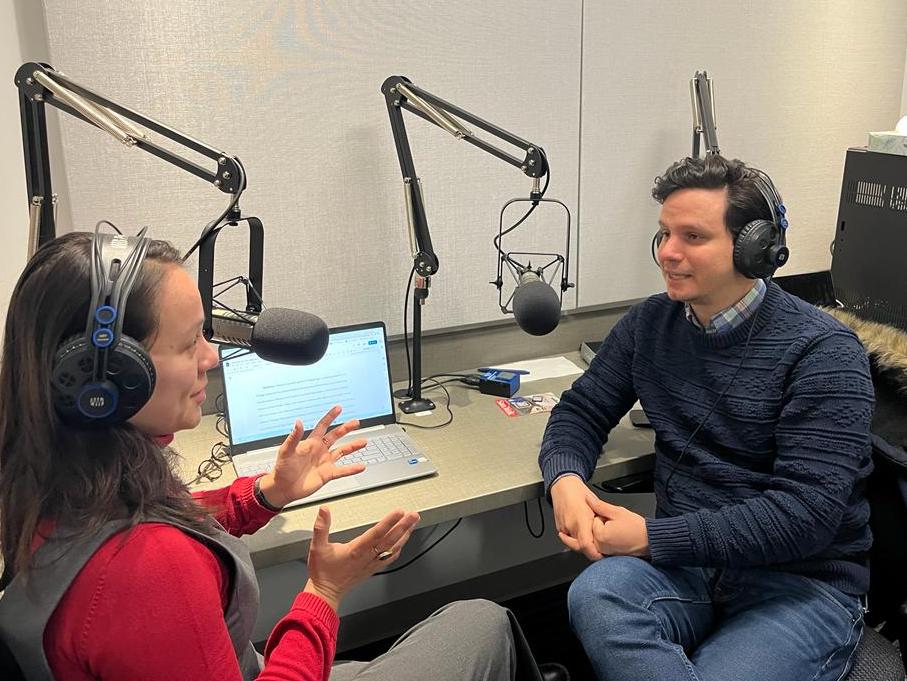
Jorge Ruiz Reyes, Research Associate at the Kellogg Institute, joins Ángel Muñoz Carpintero, JSD student and Kellogg Doctoral Student Affiliate, to discuss the role of open-source methods and technologies in documenting human rights violations. Ruiz Reyes, who holds a master’s in social data science from the University of Oxford, reflects on his work with Kellogg's Violence and Transitional Justice Lab (VT-J), developing tools to analyze disappearances and selective violence in Mexico.
Show Notes:
In this episode of Global Stage, Kellogg Doctoral Student Affiliate Ángel Muñoz-Carpintero (JSD Student) interviews Jorge Ruiz Reyes, a research associate with the Kellogg Institute Violence and Transitional Justice (VT-J) Lab, examining the crisis of disappearances in Mexico and the tools used to address it.
Ruis Reyes distinguishes between nonviolent missing persons cases and violence-related “disappearances,” and outlines three major periods in Mexico: the Dirty War (late 1960s – early 1980s), a second wave in the 1990s, and a sharp rise beginning in 2006 with the war on drugs. Today, more than 130,000 people are reported missing or have disappeared. Jorge Ruiz Reyes also explains the legal definition of enforced disappearance, which requires state involvement or acquiescence, and notes the complications that arise when state and criminal actors overlap.
He introduces a database disappearance analysis, which applies statistical methods to support the search for the missing. While disappearances have traditionally been studied through legal, forensic, and transitional justice approaches, these computational tools add a data-driven perspective. Drawing on work from truth commissions, Ruiz Reyes explains how combining multiple datasets helps correct for incomplete or biased records and produces more accurate estimates. These methods inform search strategies and public policy.
The episode also explores geospatial analysis and machine learning. Jorge Ruiz Reyes describes projects in Mexico that use predictive models to identify municipalities likely to contain clandestine graves. In Baja California, access to precise coordinates enabled a spatial model incorporating clustering patterns, distance from cities, site visibility, and satellite-detected nitrogen anomalies linked to decomposition. By combining these layers, the team identified targeted zones for investigation.
Finally, Ruiz Reyes discusses how these tools reach those conducting searches. Mexico’s 2017 General Law on Enforced Disappearances created national and state search commissions and new data systems, but families often lead search efforts themselves. In Baja California, families used the team’s model during a statewide search brigade and located clandestine graves in areas identified through the analysis. The conversation highlights how technological innovation, paired with collaboration among researchers, authorities, and families, can strengthen the search for the disappeared.
Links:
- Learn more about Jorge Ruiz Reyes
- Learn more about the Violence and Transitional Justice (V-TJ) Lab
- Learn more about the Kellogg Institute.
Listen:
Listen below, ask your smart device to “play Global Stage Podcast,” or find us on:
Apple | Spotify | Stitcher | iHeartRadio | TuneIn | YouTube