




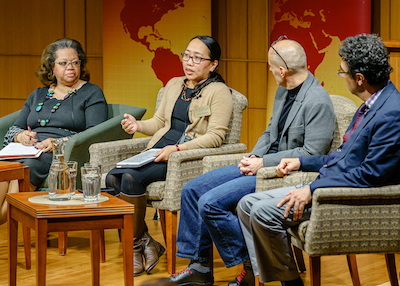


Elliot presented the research she has done with her faculty adviser, Debra Javeline, and fellow Kellogg International Scholar Kate Kirwan , titled, “Where Should People Go? Target Destinations in the Study of Climate Change”
This September, I had the opportunity to attend the American Political Science Association’s Annual Meeting in Vancouver, Canada, where I co-presented research with Professor Debra Javeline and Kate Kirwan. Our paper, “Where Should People Go? Target Destinations in the Study of Climate Change,” addresses an important gap in the study of climate migration: while much has been written about where people are leaving due to climate change, very little scholarship has focused on where people should go.
My role in the project has been designing and carrying out a systematic literature review. Kate and I developed search terms to identify over 5,000 articles on climate migration, screened each one, and narrowed them down to 50 that met our criteria for detailed analysis. From there, we coded the articles to assess whether they addressed potential destinations for climate migrants, and how they did so. We found that while many articles mention possible destinations in passing, very few offer concrete recommendations about where people should move. Given the urgency of climate change and the scale of displacement it will cause, this lack of destination-focused research is significant.
At APSA, we presented our findings in the panel Adaptation Deficits: Policies and Practices in an Accelerating Climate Crisis. It was rewarding to contribute to a conversation that brought together scholars working on different dimensions of climate adaptation and gave me a window into the culture of academia. I saw how researchers share their work, respond to questions, and engage in constructive dialogue. The feedback we received was helpful in clarifying how we frame our argument, and it gave us new ideas to strengthen the article as we move toward publication.
Another highlight of APSA for me was attending a panel on climate change adaptation and geopolitics chaired by Professor Javeline. Next year I plan to go to China to study Chinese and then pursue a master’s degree focused on international issues. As someone interested in both climate change adaptation and global politics, this panel, especially the two presentations focused on China, gave me a clearer sense of how my own interests overlap with ongoing research. Before this panel, I hadn’t given a lot of thought to trying to build a career that combines my interest in climate change with my interest in geopolitics. Not only will climate change adaptation be a defining issue of this century, but it cuts across many fields—politics, economics, sociology, and environmental science—and requires international cooperation. My time at APSA reinforced my interest in pursuing work that addresses these global challenges, whether in research, policy, or international service.