




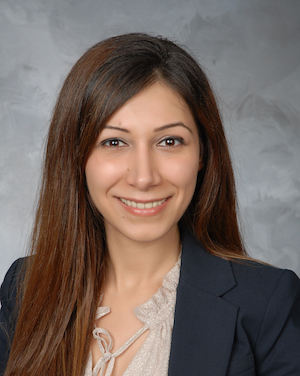
 Kellogg PhD fellow, Khawla Wakkaf recently completed her Doctor of Juridical Science (J.S.D.) at Notre Dame Law School and leaves behind a legacy of scholarship and service centered on some of the most urgent challenges in international human rights law. Through her dissertation and wide-ranging contributions to the Notre Dame community, Wakkaf has embodied the Law School’s mission to cultivate a “different kind of lawyer.”
Her dissertation, Reparations for Victims of Human Rights Violations: The Case of Refugees, explores one of the most under-theorized and critically needed areas in international law—justice for refugees who suffer harm at the hands of their host states. Wakkaf critiques the limitations of current international reparative frameworks and challenges orthodox legal thinking by proposing new criteria for meaningful and transformative redress. Her work not only offers a novel legal theory but also provides practical pathways for legal practitioners, policymakers, and institutions to create just outcomes for displaced persons.
Originally from Syria, Wakkaf earned her LL.B. from the University of Tishreen School of Law and later pursued an LL.M. at Syracuse University College of Law. At Notre Dame, she found a space that nurtured both rigorous academic inquiry and personal growth. “The process of writing my dissertation has challenged me intellectually,” she said, “but more importantly, I received incredible support and guidance from my advisor, who made a tremendous difference in my academic and professional development.” Her faculty advisor, Kellogg faculty fellow Paolo Carozza, is a renowned scholar in human rights and comparative law whose work has been recognized internationally.
"Khawla's very wide-ranging work brings together disparate ideas and bodies of law and scholarship from public international law, human rights law, and refugee law, and it is informed by both interdisciplinary work and deep personal experience,” said Carozza. “This combination has given her the capacity to make a unique and far-sighted contribution of immediate relevance to an area of acute need."
Wakkaf’s impact extended far beyond her scholarship. She co-founded the International Human Rights Society at Notre Dame Law School and served as its first president, establishing its mission and leading programming that brought pressing global issues into dialogue at the Law School. She also served as an International & Graduate Programs Ambassador and article submissions editor for the Journal of International and Comparative Law. In addition, she held research and fellowship roles at both the Kroc Institute for International Peace Studies and the Kellogg Institute for International Studies.
In 2024, she was selected as Notre Dame Law School’s first Nippon Fellow at the International Tribunal for the Law of the Sea in Hamburg, Germany—a testament to her academic excellence and global legal engagement.
Wakkaf’s understanding of what it means to be a “different kind of lawyer” is rooted in empathy, justice, and humility. “It means advocating for the rights of marginalized individuals and defending their equal and inherent dignity before the law,” she explained. “A ‘different kind of lawyer’ also signifies that a lawyer should possess a certain level of humility, honesty, wisdom, and empathy and view the law not just as a set of formalistic rules that must be applied but also as a tool for transformation and achieving peace and justice in the community.”
Established in 1992, Notre Dame Law School’s J.S.D. program prepares a small cohort of students for academic and policy leadership through rigorous scholarship and mentorship. Wakkaf’s work, both in research and in service, stands as a powerful example of the global, ethical, and justice-driven approach the program seeks to foster.