




Why do global citizens support autocratic leaders, and what can be done to mobilize support for democracy and its proponents? These questions guided the 250 scholars and practitioners from nearly 40 countries who gathered at the University of Notre Dame for the 2026 Global Democracy Conference on May 19-20.
Convened by the Kellogg Institute, part of the Keough School of Global Affairs, the conference featured political scientists, policy experts and grassroots activists who exchanged knowledge on topics ranging from gender-based violence and human rights to political behavior and the role of AI.
‘Confronting’ our current reality
Kellogg Institute Director Aníbal Pérez-Liñán welcomed participants by introducing the conference theme: “Confronting Public Support for Anti-Democratic Leaders,” noting that “confronting” carries a dual imperative.
 “The first one is the obvious idea that democratic parties need to overcome the electoral appeal of anti-democratic leaders,” Pérez-Liñán said. “But ‘confronting’ also means we need to confront the reality of this appeal; we need to understand why voters are attracted to candidates who defy basic democratic norms.”
Pérez-Liñán’s opening remarks framed a series of questions that panel discussions later addressed:
When do citizens stand for democracy? Why do voters embrace strongmen? Why do citizens turn away from human rights? What is the role of civil society in either galvanizing autocrats or supporting democratic movements? And most importantly, what can be done to promote democracy?
The broken promises of delivery
The opening plenary roundtable explored what factors cause citizens to choose either democratic leaders or strongmen. Rodrigo Zarazaga, director of the Center for Research and Social Action in Buenos Aires, highlighted the human cost of democratic failure by citing the example of Argentina’s youth, who feel abandoned by the state.
Zarazaga explained that Argentina’s middle-class promise has evaporated, leaving a “deafening silence” that fuels radical leaders. Ultimately, Argentina’s failed political system drove young and impoverished voters to support right-wing outsider and current President Javier Milei, who offers a sense of future that traditional systems lacked, Zarazaga said.
A crisis of supply, not demand
Shifting the lens to Africa, Joseph Asunka, CEO of Afrobarometer, a pan-African survey research network, reframed Africa’s democratic recession as a "supply-side crisis."
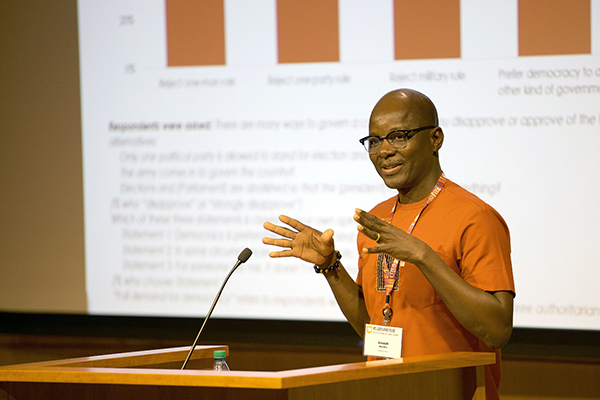 “Citizens aren't abandoning democratic values; rather, elected leaders are failing to deliver,” Asunka said.
Asunka presented data showing that while 66 percent of Africans still prefer democracy, support has dropped seven percentage points since 2011, while opposition to military rule fell 11 points. This erosion stems from political corruption and a lack of executive accountability, not economic failures, he said. Asunka concluded that building transparent institutions is vital.
"Accountability … is democracy’s immune system," he said.
Memory vs. the absolute executive
Notre Dame political scientist Luis Schiumerini, a Kellogg faculty fellow, examined what keeps citizens loyal to democratic systems despite high crime, inequality and economic distress.
 Using data from Vanderbilt University’s Latin America Public Opinion Project (LAPOP), Schiumerini noted that democratic commitment in the Americas remains resilient, heavily mediated by collective memory, transitional justice and direct experiences with state violence. In countries such as Argentina, Chile, Brazil and Mexico, beliefs about civil liberties — rather than economic performance — predict democratic support.
The nuances of public opinion were examined further in a breakout session using the AmericasBarometer 2025-26 survey from the LAPOP lab. Noam Lupu of Vanderbilt illustrated the highly divergent trajectories of the region, noting that while economic recovery can strengthen democracy, there is a worrying trend of confidence shifting away from legislature and elections toward the executive branch in the abstract.
The Keough School’s Abby Córdova, a Kellogg faculty fellow, introduced a critical concept to explain this trend: “illiberal majoritarianism.” This framework explains why citizens who express strong support for democracy in responding to abstract survey questions will simultaneously endorse authoritarian leaders.
“Democracy today is rarely overthrown through coups or abrupt regime collapses,” Córdova said. Under illiberal majoritarianism, citizens view democracy strictly as a political system where elected leaders embody the popular will and subsequently possess unrestricted authority to govern as they see fit — even at the cost of minority rights. Populist elites exploit this view by using electoral victories to legitimize power concentration, reframing democratic erosion as democratic fulfillment.
Civil society: friend and foe
The conference also included a rigorous assessment of civil society in a panel that explored how civil society groups can both help and harm democratic support.
 Helena Hofbauer, a Notre Dame graduate and the director of the Civil Engagement and Government International Program at the Ford Foundation, cautioned that not all civil society is concerned with democracy. And yet, Hofbauer noted, civil society remains a potent tool for pro-democracy forces. In 2022, youth organizers in Brazil launched a campaign encouraging 16- to-18-year-olds to register to vote, leading 2 million young people to register, a cohort that heavily supported current democratic President Lula da Silva. Similar efforts occurred in Guatemala, where indigenous movements stood up to defend the vote and ensure the 2023 election of President Barnardo Arévalo.
Tomás Gold, assistant professor of sociology at the University of Southern California, observed that many authoritarian projects emerge within the very spaces that were once counted as part of a healthy democratic system, becoming embedded in business networks, evangelical churches and think tanks, such as Victor Orbán’s networks of thought in Hungary or trade unions in Turkey.
Flávia Pellegrino of Pacto pela Democracia recounted how Brazil’s 2013 bus-fare protests in Sao Paulo evolved into a broad anti-establishment sentiment against the entire political class, inadvertently paving the way for the election of Jair Bolsonaro five years later.
“Can civil society unintentionally give place to authoritarian and illiberal leaders? Absolutely,” Pellegrino said, urging long-term, cross-ideological coalitions to defend democratic foundations.
Social media, AI and citizen participation
A plenary roundtable chaired by the Keough School’s Lisa Schirch, a Kellogg faculty fellow, explored how new media and AI are actively reshaping democratic participation, public trust and collective decision-making. The conversation largely centered on the sobering threats, with Schirch asking the central question: “Are these technologies fragmenting democracy — or creating new possibilities for democratic renewal?”
Panelists provided a nuanced view on media influence and practical interventions. The Keough School’s Dahjin Kim, a political communication expert and Kellogg faculty fellow, stressed caution in assigning causality, arguing that new media is merely a "toolkit" that is "not changing our attitudes or behaviors but only amplifying underlying patterns."
Joshua Tucker of New York University noted that in highly polarized contexts, academic research shows that changing public opinion is difficult
“The combination of social media lowering content distribution costs and AI reducing content production costs has massively increased information volume, but not necessarily its persuasive power,” Tucker said.
A key challenge is the rise of content creators lacking professional training as news sources, leading to a lack of trust in information found online. Despite this challenge, the panel identified digital literacy as the most effective countermeasure.
Political scientist David Altman of Pontificia de Cathólica de Chile called for three immediate actions: equipping civil society with "AI armories" to fight machines with machines; implementing "behavioral intelligence" to audit AI, and establishing "cooling off periods" backed by legal safeguards.
“We need real time for real humans to deliberate and calm down,” Altman said.
Panelists ultimately concluded that democracy is a human endeavor and it will not be destroyed — or saved — by algorithms.
Why is democratic backsliding happening and how can it be stopped?
 Susan Stokes, the Tiffany and Margaret Black Distinguished Service Professor of Political Science at the University of Chicago and director of the Chicago Center on Democracy, delivered the conference’s keynote address.
Drawing on her book The Backsliders: Why Leaders Undermine Their Own Democracies, Stokes argued that a widespread “taste for authoritarianism” is not the main driver of democratic backsliding. Instead, she highlighted the combined role of partisan polarization and long-term collapses in public confidence across political and societal institutions, including the press and public schools. While these factors are important, she presented joint research suggesting that the most significant structural factor in the probability of erosion is income inequality.
Backsliding leaders mold public opinion not just through polarization, which targets political parties, but through a distinct, effective strategy Stokes terms "trash-talking democracy." This strategy targets institutions such as central banks and courts. Stokes’s research found that this anti-institutional discourse effectively influences public opinion and feeds institutional nihilism.
Stokes stressed the profound implications of public opinion for global stability.
"Public opinion can accelerate or brake democratic erosion,” she said. “What is at stake is not just democracy at home, but also peace abroad." She urged less focus on anti-polarization and more on rebuilding institutional confidence, suggesting that fiscal policies and social spending could help alleviate the underlying structural factors.
Toward a strong democratic future
Conference sessions were organized with a network of global partner organizations including the Atlantic Council, the Brookings Institution, the Carnegie Endowment for International Peace, the German Marshall Fund, the Journal of Democracy, the Permanent Symposium Educating for Democracy in Latin America, and Vanderbilt University’s Center for Global Democracy, the Kellogg Institute’s partner in the AmericasBarometer project.
Ultimately, conference sessions made it clear that confronting anti-democratic tides requires more than defensive political maneuvering; it demands a fundamental restructuring of how democratic institutions deliver accountability and how scholars map the shifting desires of the global electorate. The insights and conversations generated provided a vital step forward toward building the knowledge base the world’s democracies urgently need to survive.