





The Amphictyonic Congress of Panama (1826) represents an early root of the Latin American democratic ideal. The Congress aspired not only to form a confederation of republics to resolve disputes, facilitate trade, and confront external threats, but also to the true creation of “a society of sister nations.” The Congress was thus an expression of the republican ideal shared among the newly independent states. This ideal would suffer repeated setbacks over the course of two centuries, but it was finally consolidated with the wave of democratization in the late 20th century, which culminated in the signing of the Inter-American Democratic Charter (2001).
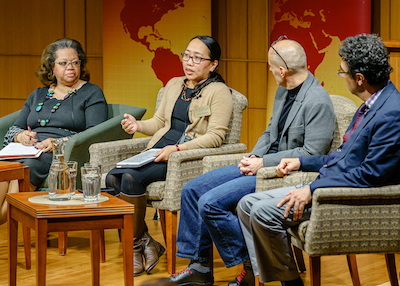
Two centuries later, one might ask: Are there distinctly Latin American republican institutions? The International Symposium on “Institutional Innovations Two Centuries After the Panama Congress” brought together some twenty specialists from universities, research centers, and international cooperation agencies in Latin America and the United States to explore this question. We sought to move beyond the defeatist narrative regarding Latin American democracy, to highlight its creativity, its originality, its capacity for innovation, and its contribution to political life in other parts of the world.
The Symposium, organized jointly by the Ministry of Foreign Affairs of the Government of Panama, the Kellogg Institute for International Studies at the University of Notre Dame (U.S.), and the Institute for Legal Research at the National Autonomous University of Mexico, explored Latin American contributions to democratic institutions, including the integration of presidentialism and proportional representation; the development of affirmative action mechanisms (e.g., quotas) and gender parity for the inclusion of underrepresented groups; the regulation of candidate selection processes (e.g., primaries); efforts toward internal democratization and public financing; and the emergence of a “transformative” constitutionalism with regional scope. We hope this Symposium will contribute to the dialogue necessary for democratic strengthening, as well as to a pluralistic, reasoned, and critical exchange. The work carried out in this public conversation is intended to be compiled into an edited volume and a series of academic publications.
Paper 1: Coalitional Presidentialism in Latin America: what to learn from it? (Magna Inácio)
Paper 2: El ciclo de vida de las coaliciones presidenciales en América Latina (Daniel Chasquetti)
Paper 3: América Latina como laboratorio democrático: paridad electoral, innovación y resiliencia (Mariana Caminotti)
Paper 4: Combatiendo la violencia política contra las mujeres para alcanzar la paridad sustantiva (Juliana Restrepo Sanín)
Paper 5: Reformas electorales y competencia intrapartidaria en América Latina en las últimas cuatro décadas (Daniel Buquet)
Paper 6: Intraparty Politics in Latin America (Lucia Motolinia)
Paper 7: Cortes, constitucionalismo transformador y Estado administrativo en America Latina (Rene Urueña)
Paper 8: Constitucionalismo, derechos y democracia en América Latina (Sandra Botero)
March 10, 2026
Opening - 8:30 am
Carlos Guevara Mann, Vice-Minister of Multilateral Affairs and Cooperation, Panama
Aníbal Pérez-Liñán, Kellogg Institute, University of Notre Dame, United States
Flavia Freidenberg, Institute for Legal Research, National Autonomous University of Mexico, Mexico
9:00–9:15 a.m. Coffee Break
Panel I: Coalition Presidentialism - 9:15–11:00 am
What are the most innovative contributions regarding presidentialism in Latin America over the past four decades?
Magna Inácio, Federal University of Minas Gerais, Brazil
Commentator: Gessica de Freitas, University of Notre Dame, United States
Daniel Chasquetti, University of the Republic, Uruguay
Discussant: Jairo Acuña Alfaro, United Nations Development Program for Latin America and the Caribbean, Costa Rica/Panama
11:00–11:10 am Coffee Break
Panel II: Democracy and Gender Parity - 11:10 am–1:00 pm
What are the main institutional contributions regarding women’s political participation and representation in Latin America over the past four decades?
Mariana Caminotti, National University of San Martín, Argentina
Commentator: Flavia Freidenberg, Institute for Legal Research, National Autonomous University of Mexico, Mexico
Juliana Restrepo Sanín, University of Florida, United States
Commentator: Claire Nevache, International Center for Political and Social Studies, Panama
March 11, 2026
Panel III: Intra-party Competition - 9:00–11:00 am
What are the main institutional developments regarding intra-party competition in Latin America over the past four decades?
Daniel Buquet, University of the Republic, Uruguay
Commentator: Nicolás Liendo, International IDEA, Panama/Argentina
Lucía Motolinia, Washington University in St. Louis, United States
Discussant: Cristhian Uribe Mendoza, National University, Colombia
11:00–11:10 am Coffee Break
Panel IV: Transformative Constitutionalism - 11:10 am–1:00 pm
What are the innovative contributions of the Judiciary to the development of the rule of law in Latin America over the past four decades?
René Urueña, Universidad de los Andes, Colombia
Commentator: Mayra Ortiz Ocaña, University of Notre Dame, United States
Sandra Botero, Universidad del Rosario, Colombia
Commentator: Salvador Sánchez, Electoral Tribunal, Panama
Closing - 1:00 pm
Closing remarks by Acting Minister Carlos Arturo Hoyos